
A Homebuyer's Guide to Mortgages
The Insights You Need to Find Your Home in Southeast Texas
Discover The Key to Financing Your Dream Home
Let's talk home-buying.
Purchasing a home is something many people aspire to do, but it can feel overwhelming, especially if this is your first time. Fortunately, you're in the right place and we're here to break it down for you!
Once you understand the importance of a mortgage and how to find the right financing solution for your needs, you have the power to take control of your home-buying journey. You'll have a clear picture of how much you can afford, how to find the best rate, and more.
Let's dive into the information and resources you'll need to take the first steps toward a place to call home.
I. Understanding Mortgage Basics
For most Americans, mortgages are the primary financial tool that enables them to purchase a home. According to Redfin, an online real estate and brokerage company, 86.2 million Americans owned a home as of September 2024. Mortgages are an essential part of the homebuying experience for most people, yet they are a topic that the general public struggles to fully understand.
In a study by MoneyWise, 1,116 Americans were surveyed on their knowledge of mortgages and buying a home; 56% failed the terminology quiz. This further affirms that many of us aren't very well-versed on the process, which poses a problem considering most people who want to purchase a home will need a mortgage to do so. Rest assured, if you fall into this category, don't fret - we're here to educate and build your confidence.
Mortgages are typically long-term commitments, with 30-year terms the most common among homeowners. That said, understanding your options is crucial for making an informed financial decision of this magnitude. Armed with this knowledge, you'll be able to search for a home that matches your needs while landing on a financing solution that’s in line with your budget.
In order to make the best decision for your finances and your future, it’s important to start with a basic understanding of mortgages. Familiarizing yourself with common terms and concepts is a great starting point for making the process feel less daunting!
What is a Mortgage?
Let’s start by breaking down the basics of a mortgage in simple terms. A mortgage is a loan from a lender to cover the purchase of a home or other residential real estate. A mortgage allows you to purchase a house with a down payment, so you don’t have to pay the full price right away. As the borrower, the home or other real estate serves as collateral for the loan balance. Most lenders offer terms ranging from 10 to 30 years. The loan amount and type determine the required down payment, the monthly payment, and other fees.
A traditional mortgage payment consists of both principal and interest costs, and sometimes private mortgage insurance (PMI). Buyers are responsible for the down payment. For a conventional mortgage, the standard down payment typically ranges from 10 to 20% of the sale price. This means that if the home price is $250,000, the down payment would be $25,000. However, it's important to know that different lenders have different requirements for other mortgage loans. At Education First, our conventional mortgages require only a 5% down payment.* This allows buyers to get into a home sooner than if they had to save for a 10% down payment and also allows buyers to hang on to more of their cash for future home expenses.
Key Terms to Know
When you’re stepping into the housing market, it can be intimidating to engage in conversations about homebuying if you don’t have a strong understanding of the terminology. To boost your confidence, it can help to review some common terms surrounding mortgages and buying a home:
- Amortization: The process of gradually spreading out loan payments over a period of time.
- Appraisal: An evaluation of the property's value, conducted by a professional home appraiser.
- Closing Costs: Fees and expenses, other than the purchase price, paid at the closing of a Mortgage loan. These typically include expenses beyond your down payment, such as a survey, title insurance policy, and recording fees.
- Down Payment: An upfront payment made by the buyer to the lender. A down payment is usually a percentage of the property's purchase price.
- Equity: The difference between the market value of a property and the amount owed on the mortgage loan.
- Escrow: A financial arrangement where a third party holds funds or property until specific conditions are met.
- Interest Rate: The percentage charged on a loan, reflecting the cost of borrowing.
- Loan-to-Value Ratio (LTV): A ratio that compares the loan amount to the appraised value of the property.
- Private Mortgage Insurance (PMI): Insurance that protects the lender in case the borrower defaults on the loan. Most conventional loans require this until the buyer has achieved 20% equity in their home.
- Principal: The original sum of money borrowed in a loan, or the remaining balance of the loan, excluding interest.
- Refinance: The process of replacing an existing mortgage with a new one. Homeowners typically refinance when they can save money by securing a lower rate or a more favorable term.
Now that you have a greater understanding of the standard terms encountered when researching mortgage loans, you can begin exploring the more complex aspects of real estate purchases.
- Fixed-Rate Mortgages: With this type of mortgage, your interest rate will stay the same for the duration of the loan’s life. That means you’ll never come across surprises or a rise in rates. You’ll know what to expect from your payments as soon as you close on your home.
- Adjustable-Rate Mortgages (ARM): An adjustable-rate mortgage, or ARM, refers to a mortgage with a variable interest rate. Typically, the rate is fixed for a period of time. After that, the interest rate on the outstanding balance resets periodically, typically at yearly or even monthly intervals. Although this option may be less predictable, there are certain situations in which it can be beneficial. Borrowers will generally have a lower interest rate for a set period, but that can change with factors such as market conditions. This is usually a better option if you plan to own your home for only a short time.
In addition to these options, there are three major categories of mortgages to consider when considering the purchase of a home.
Conventional
Conventional mortgage loans are home loans offered by private lenders such as banks, credit unions, and mortgage companies. This type of mortgage is popular among borrowers with good credit and a strong financial history, because they can take advantage of competitive interest rates and terms. Conventional loans typically require a down payment of 3% to 20% of the home's purchase price. Borrowers who can put down at least 20% can avoid private mortgage insurance (PMI), which lowers their monthly payment.
There are two main types of conventional mortgages: conforming and non-conforming. Conforming loans adhere to the guidelines set by Fannie Mae and Freddie Mac, including loan amount limits that vary by location. Non-conforming loans, also called jumbo loans, exceed these limits and may have stricter credit requirements and higher interest rates.
FHA
Designed to help more people become homeowners, FHA mortgage loans are a type of government-backed home loan. They’re insured by the Federal Housing Administration, protecting lenders against losses if borrowers default. This insurance allows lenders to offer loans with lower down payments and more flexible credit requirements, making them accessible to first-time homebuyers and those with less-than-perfect credit.
It’s important to note that FHA loans do come with some additional costs. Borrowers must pay an upfront mortgage insurance premium (MIP) at closing, as well as an annual MIP that is divided into monthly payments. These insurance premiums protect the lender but add to the overall cost of the loan. However, FHA loans remain a popular choice for many homebuyers due to their accessibility.
VA
VA mortgages are home loans backed by the U.S. Department of Veterans Affairs (VA). VA mortgages help veterans, active-duty service members, and eligible surviving spouses become homeowners. One of the biggest advantages of VA loans is that they often require no down payment, making it easier for those who have served to purchase a home without needing to save a large amount upfront.
To qualify for a VA mortgage, applicants must meet certain service requirements, such as a minimum period of active duty. They also need to obtain a Certificate of Eligibility (COE) from the VA. While the VA guarantees a portion of the loan, the loans are actually provided by private lenders, such as banks and mortgage companies. This means that while the VA has certain guidelines, lenders may have their own requirements for credit scores and income.
Explore our easy-to-follow eBook, "Everything You Need to Know About Getting a Mortgage", and take the first step toward securing the right mortgage for you!
II. Navigating Homeownership
By building your knowledge of mortgages, you’ll be better equipped to begin your hunt for the perfect home. Applying the information will be key to securing the best deal for your financial future. For example, even a small difference in interest rates can lead to substantial savings or expenses over the life of the mortgage. When you have a strong grasp on how mortgage rates work and how they are influenced by market conditions, you’re more likely to lock in a favorable rate.
The road to homeownership won’t look the same for everyone, but there are some key guidelines you can follow to ensure you’re on the right path. With a clear picture of what you can afford, you have the ability to create a more comfortable living situation for yourself and avoid getting in over your head with payments that are too high.
So, how can you get started? First, you’ll need to reflect on your current finances and create a realistic budget. Remember to consider the total cost of homeownership, including property taxes, insurance, and maintenance. These expenses can add up quickly and should be accounted for in the total cost of a home.
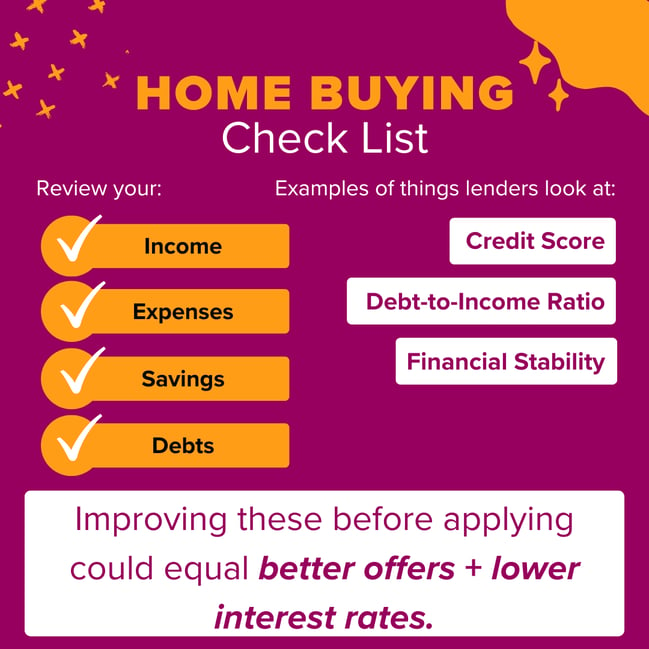
Conducting a thorough self-assessment of your finances is essential before beginning your search for a home. This will provide you with the opportunity to identify areas for improvement before settling on mortgage terms. Lenders evaluate your credit score, debt-to-income ratio, and overall financial stability to determine loan eligibility and interest rates. When you work on these factors ahead of time, you may be eligible for better rates and potentially save thousands over the life of your loan.
Another important factor when assessing your financial situation is making sure you know the costs that will come with closing costs, and are familiar with reserve costs- proof that you have enough funds after a home purchase for emergency situations.
Buying a home is a significant commitment, and being financially prepared ensures you can enjoy your new home without the stress of unexpected financial burdens. It will ultimately allow you to focus on making your house a home.
Credit Score
A good credit score is essential when seeking a mortgage for a new home because it directly affects your loan eligibility and interest rates. It essentially serves as an indicator of your reliability as a borrower. A higher score shows lenders that you pose less of a risk, leading them to offer lower interest rates and better loan terms. This can save you a significant amount of money over the life of your mortgage.
There are several factors that impact your credit score, including your payment history, credit utilization, length of credit history, new credit accounts, and types of credit used. Late payments, high credit card balances, and numerous recent credit inquiries can negatively affect your score. Keep in mind, opening new credit during the homebuying process can lower your credit score and increase your debt, which may jeopardize your mortgage approval. Always remember, consistently paying bills on time, keeping credit card balances low, and maintaining a long credit history can raise your score.
To improve your credit score, start by checking your credit report for issues and disputing any errors. Make it a priority to pay your bills on time. Setting up automatic payments can help ensure you never miss a due date, which is key to maintaining a strong credit history. Avoid opening new credit accounts unless necessary, and try to keep old accounts open to maintain a longer credit history. These steps can help raise your score, making you a more attractive mortgage candidate.
Debt-to-Income Ratio
Your debt-to-income (DTI) ratio is a critical factor to lenders when they’re evaluating your application. It measures your monthly debt payments against your gross monthly income, helping determine your ability to manage the additional debt that a mortgage will bring. A lower DTI ratio shows that you have a good balance between debt and income, making you a trustworthy borrower.
Lenders tend to prefer a DTI ratio of 36% or lower, though some may accept higher ratios depending on other factors. To calculate your DTI, add up all your monthly debt payments, including credit cards, car loans, and student loans, then divide by your gross monthly income.
To improve your DTI ratio, the idea is to lower your debt. To accomplish this, you should plan to pay down high-interest debts or consolidate loans to lower monthly payments. Then, avoid taking on new debt before applying for a mortgage. This not only enhances your mortgage prospects but also contributes to your overall financial health.
Making a Purchase
If you’ve completed your financial checkup and feel that you’re ready to move forward with buying a home, it can be both exciting and overwhelming. This is especially true if you're a first-time homebuyer. To prepare for your homebuying journey, here are the typical considerations to keep in mind.
- Saving for a Down Payment: A common mistake is overlooking how much you need to save toward the down payment. First, determine how much you need by researching typical down payment requirements for the type of loan you intend to pursue. Set up a dedicated savings account to keep your funds separate and organized. Be sure to create a budget that allocates a portion of your income toward this goal, so that you're consistently contributing to your savings.
- Getting a Mortgage Pre-Approval: Gather all necessary financial documents, such as income statements and tax returns, to streamline the pre-approval process. Most realtors will want this before they start showing your houses to make sure that what you are looking at is actually something that you can afford. The Education First FCU Mortgage team can help you get pre-approved quickly.
- House Hunting: At this point, you'll want to define your wants and needs in relation to your budget. This will help you narrow your search and prevent you from falling in love with a home you ultimately can't afford. Working with a real estate agent who understands your preferences and will help you explore listings that meet your criteria. Now is the time to attend open houses and schedule home tours to get a feel for the properties and neighborhoods. We recommend reputable sites like Realtor.com and Zillow.com as you hunt for the perfect home.
- Making an Offer: With an agent's guidance, decide on a competitive offer price based on market conditions and the home's value. Submit the offer through your realtor and be prepared for negotiations, as sellers may counter with different terms. Once an agreement is reached, you will sign a purchase agreement to move forward with the purchase.
- Home Inspection and Appraisal: Plan to hire a professional inspector to evaluate the home's condition and identify any potential issues that could result in unexpected and/or costly repairs. An appraisal will also be completed to determine the property's market value, ensuring it aligns with the purchase price.
- Closing Process: After your offer is accepted and you've completed the home inspection and appraisal, you'll move toward closing, a process that typically takes 30 to 45 days from initial disclosures. This stage includes a final walkthrough to ensure the property is in the agreed-upon condition, reviewing and signing numerous documents, and paying your closing costs, which usually is between 2% to 6% of the home's purchase price. Sometimes, the closing process can take some time, as it includes final steps such as property title search, property survey, and final signatures on all binding documents. Rest assured though, as long as you are working with a knowledgeable realtor and lending partner, your closing process will have minimal stress.
Keep in mind that the home buying process is not one-size-fits all. While some homebuyers may find precisely what they are looking for early in their search, others may have to look for several weeks or even months to find a home that is the right fit for them and their budget.
Exploring Mortgage Refinancing
With time, you may find that your mortgage needs as a homeowner have changed. Refinancing is a financial strategy that involves replacing your existing mortgage with a new one, usually to secure a better rate or term. There are a few notable situations where homeowners may benefit from refinancing their mortgage:
- Lower Interest Rates: If current market rates are lower than your original mortgage rate, refinancing can reduce your monthly payments and overall interest paid.
- Shorter Loan Term: Refinancing to a shorter term can help you pay off your mortgage faster and save on interest over time.
- Switch Loan Type: Moving from an adjustable-rate mortgage to a fixed-rate mortgage can provide stability in your monthly payments.
- Access Home Equity: Refinancing can help you tap into your home equity to cover major expenses, such as home improvements or debt consolidation.
- Remove Private Mortgage Insurance (PMI): If your home value has increased, refinancing might eliminate the need for PMI, thus reducing your monthly costs.
- Improved Financial Situation: If your credit score has improved, refinancing could qualify you for better loan terms and lower interest rates.
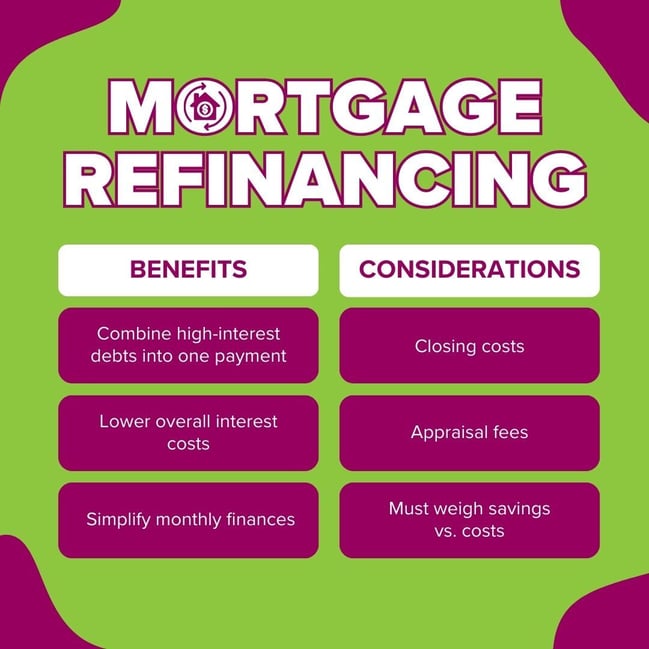
Refinancing can also be a useful tool for managing debt if you have equity in the home. This is called a cash-out. By consolidating high-interest debts into a single, lower-interest mortgage payment, homeowners can simplify their finances and lower overall interest costs. This can be particularly helpful for those with significant credit card or personal loan debt.
However, it's essential to consider the costs associated with refinancing. Closing costs, appraisal fees, and other refinancing expenses can add up, so it's vital to weigh them against the potential savings. A second consideration is that a cash-out refinancing may increase monthly mortgage payments. Be aware that by rolling unsecured debt into your mortgage loan, your home could be at risk if you are unable to make those payments in the future. Whereas if you had left those debts unsecured, your home would be protected.
If considering a refinance to consolidate debt, homeowners are wise to carefully evaluate their financial situation and goals to determine if refinancing is the right move.
Explore our mortgage options, competitive rates, flexible terms, and expert guidance for homebuyers in Southeast Texas!
III. Starting The Mortgage Application Process
As we mentioned earlier, understanding your financial situation will be key to beginning the mortgage application process. Next up is getting organized and gathering the necessary documents. These typically include proof of income, tax returns, bank statements, and a form of identification.
It's also helpful to determine how much you can afford to borrow in advance. To do this, consider your current financial obligations and how a mortgage payment will fit into your budget. Using a mortgage payment calculator can be a helpful tool in estimating your monthly payments, allowing you to play with different loan amounts, rates and terms to see how they affect your plan. This planning will give you a better understanding of what you can afford and help you avoid overextending yourself.
With these details in place, you’re ready to take the next step and begin the Mortgage lending process.
Getting Pre-Approved
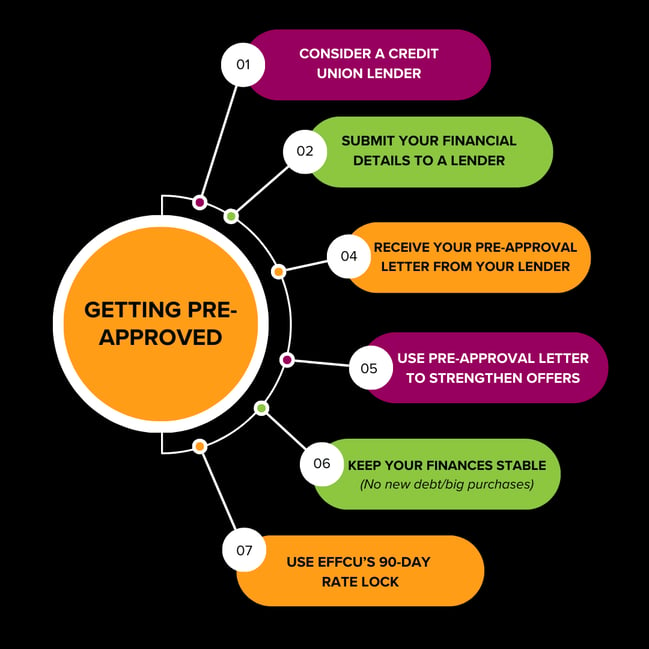
Getting pre-approved not only gives you a better idea of what you can afford but also shows the seller that you're taking this process seriously. There are many options when it comes to Mortgage lenders you can get pre-approved with, but there are specific perks to working with a credit union Mortgage lender. One major advantage includes local, in-house lending. This means your home loan is originated with Education First FCU and will not be sold to another lender or servicer. Larger Mortgage lenders tend to sell the Home Loans they finance, potentially causing more issues for you in the future because you may have to deal with multiple lenders throughout the life of your loan. With a credit union, this is not the case. The loan is held with the credit union for the entire life of the loan, allowing you the ease of working with one lender.
To get pre-approved, you’ll need to submit detailed financial information to a lender, who will review your credit history, income, and assets. If everything is acceptable, they will then provide a pre-approval letter that outlines the loan amount you qualify for and the potential interest rate. This letter can be a great tool when making offers on homes, as it shows sellers that you have the financial backing to follow through on the purchase.
Keep in mind, pre-approval is not a guarantee of a mortgage. However, it does provide a clearer picture of your borrowing capacity and can help you narrow down your home search to properties you can afford. It can also speed up the final mortgage approval process once you've found a home you love.
Once you’re pre-approved, it’s vital to keep your financial situation stable. This means avoiding large purchases or taking on new debt, as this can affect your credit score and the terms of your final mortgage approval. If you do get pre-approved with Education First, we also offer a 90-day Rate Lock, letting you secure your interest rate while you shop for your dream home.
Begin the Home Shopping Process
Once you are pre-approved, it's time to start looking for a home! Now that you have determined a good estimate of what you can afford and have an official pre-approval, you can begin viewing properties with a realtor.
When choosing which home to buy, consider things like "What city do I want to move to?" "Does the school district impact my decision?" "Do I want to live in an urban area, or in a more rural neighborhood?" Your realtor will be your best friend throughout this process, as they can talk you through all your questions and help you identify the best homes for you to tour.
In addition to your realtor, other sites that help determine the best area to live in include credible sites like DataUSA.io, or Niche, which share valuable information, such as a city's population, economic data, average cost of living, and growth rate. Recent trends have also pointed to Facebook neighborhood groups as an increasingly popular resource for evaluating potential neighborhoods.
Finalizing the Details
Once you get pre-approved, determine the neighborhood and home you want to buy. Now is the time to submit a formal application for a mortgage with your lender! Start by reviewing the loan estimate they’ve provided - this should outline the terms of your loan, with the interest rate, monthly payment, and closing costs. Make sure everything matches what you discussed and lines up with your expectations.
Upon final agreement with your lender, realtor, and seller, you’re on your way to closing on your new home. There will still be a lot of paperwork heading your way, so take the time to read everything in detail and ask questions. Your lender or a closing agent can guide you through the closing process, explaining each document and answering any questions you may have. Upon finalizng all details and documents, you will officially be a new homeowner! Congratulations on this very exciting journey!
Connect with a trusted local mortgage advisor to guide your next home-buying step!
Whether you have a mortgage or pay rent, both require a monthly payment to live in the property. However, there are some key differences to note. With a mortgage, you're working toward owning the property, building equity with each payment, which can be an investment for the future.
When you rent, you're simply paying for the right to live in the property without gaining any ownership stake. In addition, homeowners with a mortgage are responsible for maintenance and repairs, adding to costs, whereas renters usually have these covered by the landlord. Renting also offers more flexibility to move without the long-term commitment of owning a home.
Mortgage rates are determined by several factors, including the economy as a whole, inflation, and the Federal Reserve's monetary policy. Lenders also consider your credit score, loan amount, and down payment. Plus, the type of mortgage (fixed or adjustable) and the loan term can influence the rate.
Start by calculating your monthly income and expenses to understand how much you can comfortably allocate to a mortgage payment. Then, consider the size of your down payment, as a larger down payment can reduce your monthly payments and interest rate. With online mortgage calculators, you can more easily assess your situation, and an Education First FCU Mortgage expert will be able to help with anything you need as well!
At this point, you own your home outright and no longer have monthly mortgage payments. Your lender will typically send a mortgage release or satisfaction document, which confirms that the loan is fully paid. It's important to ensure this document is recorded with your local government to clear the lien on your property. Remember, you'll still be responsible for property taxes, homeowner's insurance, and maintenance.
Resources
- Mortgage Process Explained || Investopedia
- First Time Home Buyer || Investopedia
- 10 Reasons You Shouldn't Skip a Home Inspection || Investopedia
- How to Get a Mortgage || Nerd Wallet
- How to Get a Mortgage || Bank Rate
- What is Home Equity || Bank Rate
- Inflation Housing Market || Bank Rate
- Understanding the Different Kinds of Loans Available || Consumer Finance
*Down Payment as low as 5% for Qualified applicants. Rates depend on individual creditworthiness and are subject to change without notice.
